
It’s very hard to say energy and not say water in the same sentence. They are completely interconnected systems
The need for clean and sustainable energy sources is quite evident for fossil fuels which have number of drawbacks: such as emissions of greenhouse gases, finite reserves, and dependence on a few oil-exporting regions in the world. Current sustainable energy sources include solar, wind, biomass, and hydro energy. A significant potential of clean energy exists in the form of water streams with different salt concentrations. The energy inherent in salinity-gradient energy is also called BLUE ENERGY and is available where ever fresh water streams flow into the sea. In general, techniques currently available for desalination could be used to generate power from salinity gradients when operated in the reversed mode.
THE 20-20-20
The current energy production is largely based on fossil fuels and is not only characterized by vulnerability and imminent scarcity but also by emission of greenhouse gasses as a consequence of the combustion of fuels. Each of these concerns should provide enough motivation for drastically reducing the use of fossil fuels. This should be done by reducing the energy demand (consumption) and by changing the energy supply (sources and production). In 2020, the three 20’s will be mandatory for all EU countries: 20% energy saving, 20% CO2 reduction and 20% renewable energy. Each country can deviate slightly from the 20% renewable energy as part of the whole energy portfolio, but this will also drive a third factor: the development of renewable non-CO2 energy sources. [1]
WHAT IS BLUE ENERGY??
The largest surface of the Earth is covered by the sea and the oceans, which capture most of the solar energy. By solar irradiation and heating of the salt water of the ocean a de-mixing takes place and fresh or sweet water is formed in clouds. When a river runs into a sea, spontaneous mixing of fresh and salt water occurs. This natural process is irreversible; no work is attained from it. However, if the mixing is done (partly) reversibly, work can be obtained from the mixing process. The globally available power in form of salinity gradients has been estimated in the 1970’s (on the basis of average ocean salinity and annual global river discharges) to be between 1.4 and 2.6 TW, which is approximately 20% of the worldwide energy demand and more than the global electricity consumption (2.0 TW). [2]
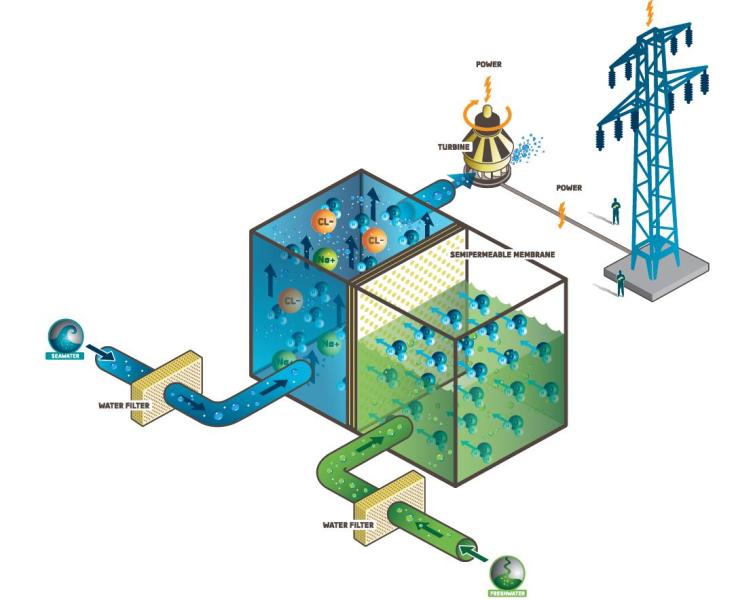
Salinity gradient energy is based on using the resources of “osmotic pressure difference between fresh water and sea water.” [3]. When a drop of salt water falls into a lake of fresh water, there is a spontaneous net motion of the ions in the water. The reason why ions move is that the entropy of the mixed system is larger, and hence the free energy is lower. This energy is called “Blue Energy‟ which is nonpolluting, sustainable technology to generate energy by mixing water streams with different salinity. World’s first osmotic power plant with capacity of 4 kW was opened by Statkraft on 2009 in Tofte, Norway. This plant is able to produce 1W/m² of membrane which is obtained at 10 liter of water flowing through the membrane per second, and at a pressure of 10 bar. [4]
WORKING PRINCIPLE
It uses the Gibbs energy of mixing of two salt solutions with different concentrations to generate electrical energy. In order to obtain energy from salt water, two solutions of different concentration must be available. The energy that can be extracted from the two solutions is directly proportional to the absolute temperature, T (K). Because the mixing of two solutions is a spontaneous process, the Gibbs energy of mixing is negative: energy is released when two solutions are mixed. The theoretical available amount of energy available from the mixing of two salt solutions can be calculated and thus the theoretical potential of salinity gradient energy can be evaluated.
By mixing 1 m3 fresh water per second with an excess of seawater, considered as a salt solution with a salt concentration c=0.5 molar, the maximum recoverable dissolution energy is ΔG = -2.35 MW.
PROS AND CONS
A big advantage is that it is renewable. This is as green as energy gets; the only waste product is brackish water. It’s also a weather-proof technology as it’s not reliant on erratic forces. It is a very “clean” process. The amount of heat that occurs in the process would raise the temperature less than half a degree Celsius, which is not harmful to the marine organisms.
When we come to the disadvantages one big obstacle is the costs. Compared to other energy producing processes osmotic energy is expensive as compare to conventional power plant. There are also engineering problems to be overcome. It is difficult to build a large plant and lower it in the sea as deep as 110 meters.
FUTURE PROSPECTS
The possibility to use the salinity gradient in the ocean for power lies within the technology that needs to be developed. There are currently two hurdles to overcome, which includes the membrane water part and sunlight. If we could develop the membrane to use salt-water as fresh water and brine with a higher salt-concentration as the concentrated solution, then it would be more feasible to use salinity for power. Or, the vapor pressure technique could be further developed. However, the biggest hurdle that needs to be overcome is the cost.
SUMMARY
Blue-Energy is a promising renewable energy source for the future. Over 80% of the current global electricity demand can be met through ‘Blue-Energy’. This translates into reduction of approximately 40% of global energy-related greenhouse gas emissions; however, significant efforts are still required to make salinity gradient energy competitive as compared to other renewable energy sources. i) For PRO, the main challenge is the reduction of external and internal concentration polarization. ii) For RED the main challenge is the reduction of the internal stack and membrane resistance. iii) It is also necessary to perform process optimization and system scale-up before this technology can be exploited commercially. Further it is important to evaluate the effect of such a system on the ecology, shipping traffic and recreational activities in the neighborhood.
References:
- Briefing Paper about Blue Energy Kees van denEnde & Frederik Groeman KEMA Consulting October 2007
- O. Davidson, B. Metz, Special report on carbon dioxide capture and storage. Climate Change “Recent developments in salinity gradient power”. Oceans. 2003. 2284-2287.
- John Gartner (2009-11-24). “World’s First Osmotic Power Plant Opens”
(http://www.reuters.com/article/2009/11/24/us-norwayosmotic idUSTRE5AN20Q20091124). - Jones,A.T.,W. Finley. “Recent developments in salinity gradient power”. Oceans. 2003. 2284-2287.
The detailed article can be accessed from: https://www.researchgate.net/publication/288839358_Blue_Energy_-_Power_from_the_Sea

 Committed to learning
Leave a comment