

Suppose, your mobile phone get discharge and you could shout at it to charge it again… Or it could also get a charge on the road by honking and traffic noise.
A sound is a form of energy which travels in the shape of a wave, that could be used to convert it into electric energy or another form of energy.
For each 100dB we get 0.5 V which means 1000dB for 5V that is enough to charge mobile phones.
There can be three possible methods of which sound energy converted into electric energy.
- Force (Sound)
Sound energy is a mechanical energy it could be converted into electricity as mechanical energy can be converted into electricity by the law of thermodynamics.
Conversion of sound energy into electric energy is based upon the “Faradays law of electromagnetic induction” which states that the induced electromotive force in any closed loop is equal to the negative of the time rate of change of the magnetic flux through the circuit.
Suppose a very thin curtain like diaphragm which gets fluctuated by the oscillation placed in between of magnetic bar. When it fluctuates, the sound wave will create pressure. This pressure will create a movement in the conductor which is attached to the curtain. This movement will affect the magnetic field of the magnet and thus generate motional emf and will produce a voltage across it.
Thus, the oscillation formed by the sound wave could be converted into electricity. Its limitation is that it will be effective only in the place where high decibel of sound is available such as nuclear power plant, industries using huge and noisy machines.
- From Heat Energy

Sound energy can be converted into heat energy as sound wave travel by oscillating the particles of the medium. When sound energy travels through any medium, the particle collides with adjacent particles and disturbs the particles of the medium. This collision will result in the production of heat energy. The production of heat energy is more in a denser medium so a material with high energy density can be used to convert sound energy into heat energy.
This method is less efficient due to additional energy losses taking place during conversion of sound energy to heat energy and then heat energy to electric energy.
- From Piezo-electric material
When the material is stressed, mechanical strain energy gets converted into electric energy. These materials are known as piezo-electric materials.
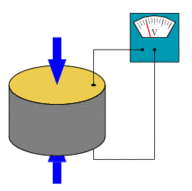
The mechanical energy of sound is applied directly to a crystal with strong piezoelectric characteristics, and the crystal will generate a small amount of voltage in response to the application of that energy. Just like squeezing the crystal and when the crystal is released, a small voltage is generated.
Materials like Quartz, DNA could not be able to convert as they formed naturally, but artificial material like calamine lotion can convert sound energy into electric energy.
Way Forward
If we can convert sound energy to electric energy efficiently, it could help us to reduce the scarcity of electrical energy worldwide and reduction of CO2. The noise pollution on the road would be able to convert into electric energy and lights the signals, street lighting, and various other electrical appliances.
With the advancement of this technology, we can also imagine the charging of various battery-operated devices such as mobile phones just by making a call and talking.
Its other application field includes the lightening of the street lamps and traffic lights just by extracting the sound energy of the noise that is produced by the vehicles on the road.
Also in the industries where massive amount of the noise is produced as a result of the functioning of heavy machinery this sound can be trapped and can be used to run the low power machines used in production process.

 Committed to learning
Leave a comment